
Economical
Protect more coastline for less with an autonomous, 24/7 solution.
Autonomous surface vessels
HavBotics builds the BeachDefender: autonomous vessels that work in pairs to sweep seaweed mats away from Caribbean beaches, 24/7, before they make landfall.
Concept render
The problem
From Mexico to the Lesser Antilles, the world’s most beautiful beaches are vanishing under millions of tons of rotting seaweed. Tourists leave. Hotels empty. Billions in tourism spending wash away with every bloom.
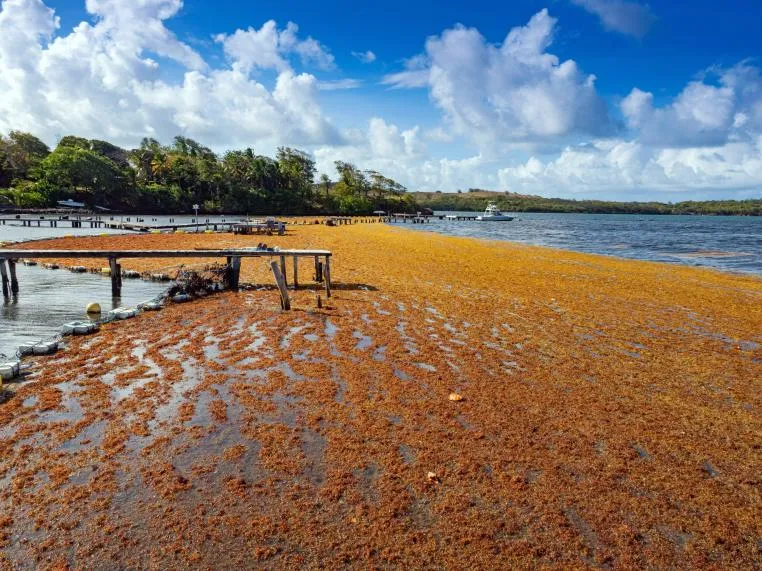
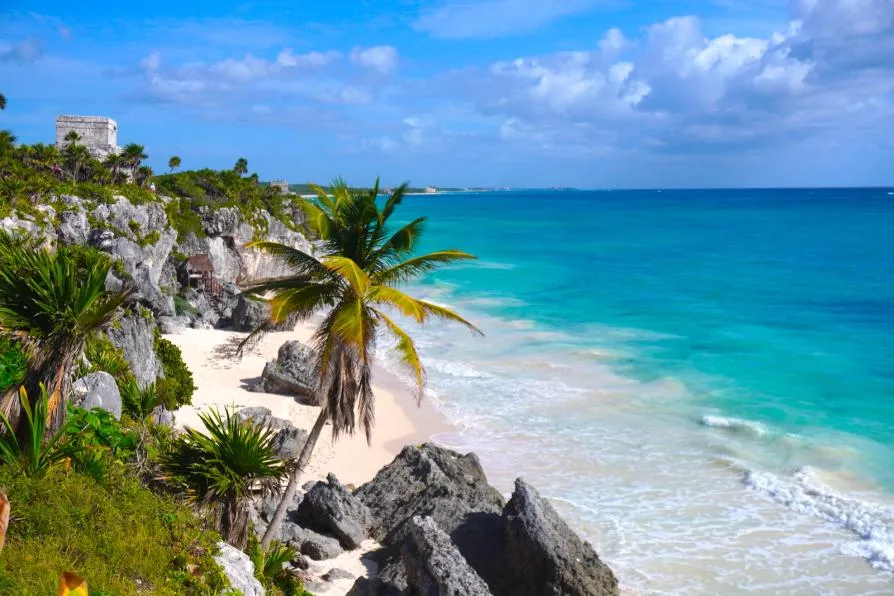
The trend
33.5 million tons of sargassum floated in the Atlantic in June 2026, a record. The Great Atlantic Sargassum Belt has returned every year since 2011, and it keeps growing.
| Year | Total | At sea |
|---|---|---|
| 2019 | 43,000 | 544 |
| 2020 | 25,000 | 808 |
| 2021 | 54,000 | 1,000 |
| 2022 | 66,000 | 3,000 |
| 2023 | 51,000 | 2,000 |
| 2024 | 41,000 | 1,000 |
| 2025 | 93,000 | 11,000 |
| 2026 | 96,000 | 16,000 |
2.2×
Growth in Mexico’s annual haul since 2019.
16K t
Collected at sea in 2026, up from 544 t in 2019. Offshore is where the fight is moving.
Sources: Mexico Navy Secretariat and municipal governments (via Reuters); NASA Earth Observatory; University of South Florida Optical Oceanography Lab.
Status quo
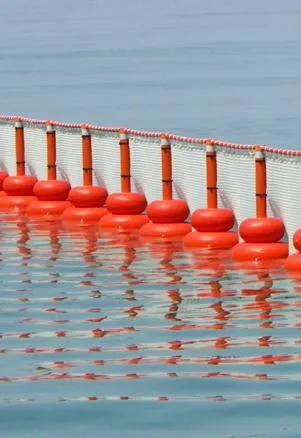
Fixed booms guard a single stretch, struggle in heavy swell and need constant upkeep.
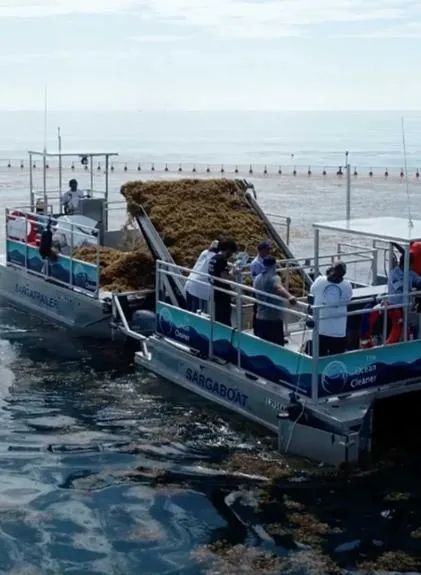
Crewed, costly by the hour and limited to calmer nearshore water.
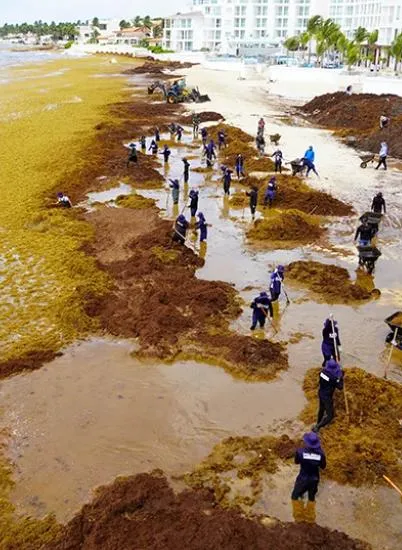
Raking and hauling only starts once the seaweed lands, so beaches still close.
Coastlines spend millions every season, and most of it goes on cleanup after the damage is done.
The solution
An autonomous catamaran built for one job: keeping sargassum off your coastline.
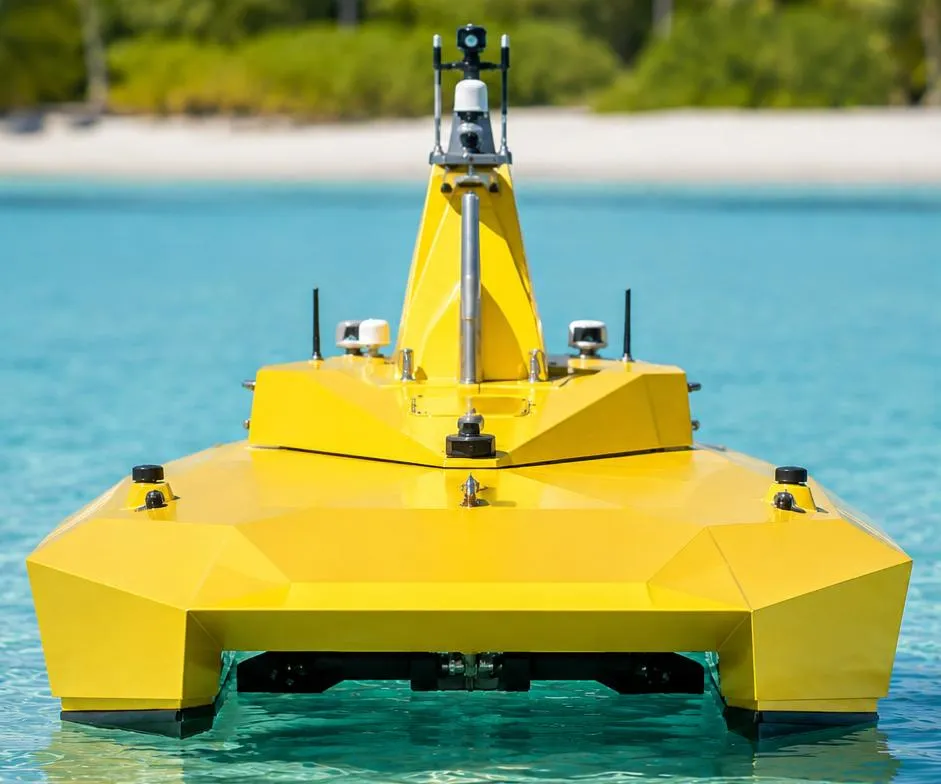
Protect more coastline for less with an autonomous, 24/7 solution.
Redirect the largest sargassum mats while they’re still at sea.
Protect beaches without harming marine life or watercraft.
Engineering
Commercial components, a modular build and twin mechanical diesels keep each vessel reliable at sea and repairable in any Caribbean port.
Starlink for beyond-line-of-sight links, AIS transceiver, GPS/RTK positioning, 360° cameras, navigation and status lights.
Onboard computer with AI navigation and obstacle detection, geofencing, mission control and remote monitoring.
Two independent marine diesels drive gearboxes and props directly. Simple, reliable, locally serviceable.
Engine-driven alternators charge a battery bank feeding a redundant 24/48V DC house system.
Reinforced central tow bridle with integrated load cell and remote or manual release, designed for paired operations.
Stable catamaran hull in marine-grade aluminum, foam-filled for unsinkability. Corrosion resistant, low maintenance.
Ducted, guarded props resist seaweed entanglement, with reverse-clearing capability.
How it works
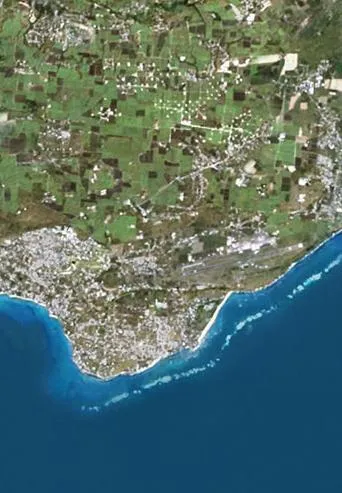
NASA PACE satellite imagery maps floating algae, and drift models forecast where and when mats will reach a protected coastline.
A BeachDefender pair tows a special net to gather the mat while it’s still at sea.
The mat is steered past the coast, to a managed landfall or to a pickup point, with live monitoring onshore.
Steer the mat into a current that carries it past the coastline entirely.
Deliver it to a designated landfall site where it’s easiest and cheapest to manage.
Bring it to a water pickup point for collection, and on to industrial partners.
Business model
Customers pick a level of protection, and we put enough BeachDefender pairs on the water to deliver it.
Baseline target pricing
$180USD
per quarter kilometer of beach, per day
That’s $720 per kilometer, in US dollars.
Protection levels
Divert ~20% of incoming blooms, focused on the largest mats.
More pairs in service for wider, more consistent coverage.
“No sargassum touches your beach.” Our premium offering.
Team
Our leadership team is in stealth, currently in executive roles at autonomous technology, defense and watercraft engineering firms.
Leadership roles: CEO · CGO · CTO · COO
Pre-seed funding round
Pre-seed capital takes BeachDefender from design to validated pilot, with real vessels, real water and real customers.
Investors: request the full brief and financial model. Governments, resorts and tourism boards: talk to us about a pilot on your coastline.
Priority access for public partners. Governments, associations and tourism boards that also invest get priority for pilots and active protection missions.
Prefer email? contact@havbotics.com