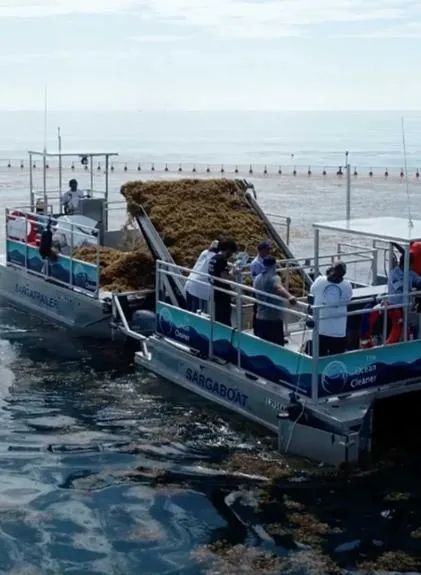
Quintana Roo alone collected 120,000 tons of sargassum from its beaches by mid-October 2025.1 Most of what the Caribbean collects is still trucked to landfills or left to decompose. But a growing set of companies and researchers sees the same seaweed as a raw material.
Building blocks
The best-known example is Sargablock, founded by Omar Vázquez Sánchez in Puerto Morelos, Mexico. His company presses ground sargassum, mixed with other materials, into construction blocks, and has used them to build homes for low-income families.2 Reports put sargassum at roughly 40% of each block. The first house, Casa Angelita, has reportedly survived five hurricanes.23
Fertilizer and biostimulants
Sargassum is rich in minerals and has long been tried as a soil amendment. The catch is arsenic. Researchers at the University of the West Indies measured 58 to 65 ppm of arsenic in sargassum collected around Jamaica, and recommend controlled uses such as nursery seedlings rather than spreading it on farmland.4 A 2026 scientific review calls heavy metals, especially arsenic, the main barrier to using sargassum in food and animal feed.6
Biogas and biofuels
Sargassum can be digested to produce methane, with yields that depend on how finely it is ground and what it is blended with. The leftover digestate still contains arsenic and zinc, so it needs treatment before any agricultural use.5 In the Jamaican experiments, biogas sludge reached 76 ppm of arsenic and was judged unsuitable for soils.4 The 2026 review recommends a biorefinery approach, extracting several products from the same seaweed in sequence rather than relying on a single use.6
From cost to industry
Governments are starting to treat sargassum as a supply chain. In November 2025, Mexico’s fisheries research institute, its agriculture ministry, the Riviera Maya Hotel Association and The Seas We Love signed an agreement to turn collected sargassum into biofertilizers, biofuels and alternative materials, with a state-donated site planned as a processing hub and tax incentives for processing companies.7
Roughly how long sargassum can sit on a beach before it starts to decompose and release hydrogen sulfide, according to the US EPA.8
Why collecting it at sea matters
Every one of these uses works better with fresh, clean feedstock. Sargassum that has sat on the beach for days is mixed with sand and debris and is already decomposing.8 The 2026 review treats floating sargassum as the cleanest baseline for high-value applications.6 Seaweed gathered offshore can reach a processor sooner and cleaner, which may make it worth more.
That is one of the opportunities HavBotics is exploring. If a BeachDefender pair redirected a mat to a collection point instead of the beach, the coastline would avoid the cleanup, and HavBotics could supply the seaweed to partners that use it in beauty, fertilizer, fuel or building products. Whether that full cycle can become revenue is one of the questions HavBotics’ planned pilots would test.
Sources
- Por Esto, closing of the 2025 sargassum season in Quintana Roo (October 7, 2025)
- Mexico News Daily, “Mr. Sargassum built 13 houses with seaweed blocks”
- Riviera Maya News, “Sargablock: Quintana Roo’s Sargassum-Building Strategy to Be Replicated in Ghana”
- Mona Webber, “Sargassum seaweed: what to do and what not to do with it”, Jamaica Gleaner (April 9, 2023)
- Anaerobic digestion of pelagic Sargassum for biogas, Resources (MDPI), 2025
- Fagundo-Mollineda et al., “Sargassum: Turning Coastal Challenge into a Valuable Resource”, Biomass (MDPI), 2026
- Riviera Maya News, agreement to turn Quintana Roo’s sargassum into an asset (November 16, 2025)
- US EPA, “Sargassum Inundation Events (SIEs): Impacts on Human Health”