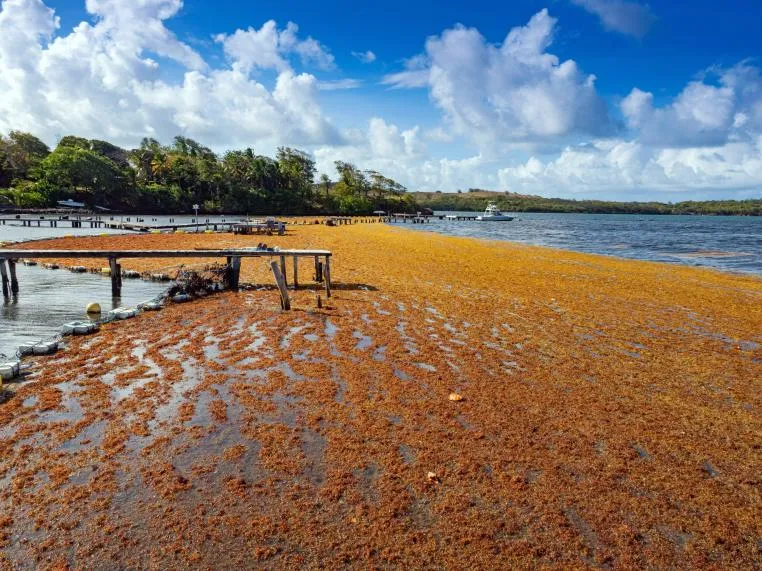
Every season, sargassum turns some of the Caribbean’s most valuable shorelines into brown, sulfur-smelling mats. The price is rarely counted in one place. It is split across hotel maintenance budgets, municipal contracts, lost bookings and public health. Pulling the published figures together gives a clearer picture of what a coastline actually pays.
The visible bill: cleanup
Cleanup is the easiest cost to count. The US Environmental Protection Agency puts the cost of cleaning up sargassum across the Caribbean at $120 million in 2018 alone.1 The blooms have grown since: 2025 was the largest sargassum year in the satellite record, and 2026 the second largest.2
In Mexico’s Quintana Roo, much of the burden falls on hotels. The president of the Riviera Maya Hotel Association estimates that the state’s hotels spend about US$150 million a year on sargassum, and 2025 spending was reported above 2.7 billion pesos.3 Earlier reporting found individual beachfront hotels paying US$70,000 to $90,000 a month to keep their sand clear.4 In the US Virgin Islands, the natural resources department estimated that removing a dense, decomposing inundation costs $25,000 a day.1
Estimated annual spend by Quintana Roo hotels on sargassum, according to the Riviera Maya Hotel Association.3
The bigger bill: lost tourism
Cleanup is only part of the cost. When beaches close or visitors cancel, the loss shows up as empty rooms, quieter restaurants and fewer tours. A modeling study for Puerto Rico estimated the expected annual economic impact of sargassum at $782 million, within a range of $114 million to $1.6 billion.5
In the Mexican Caribbean, local press reported summer 2026 hotel occupancy of 55% to 70% depending on the destination, with restaurant workers describing far fewer customers on sargassum days. The federal government attributes the slowdown to other factors, including jet fuel prices, a reminder that tourism numbers have many drivers.6 But few travelers book a beach vacation hoping for brown water, and images of covered beaches travel fast.
The hidden bill: health and the shoreline
After about 48 hours on the beach, sargassum begins to decompose and release hydrogen sulfide and ammonia.7 The EPA notes that prolonged exposure to hydrogen sulfide can cause airway irritation, nausea and headaches, and advises people with asthma to limit time near decomposing mats.7 The workers who rake and haul sargassum every day are the most exposed. Heavy machinery on the beach can also remove sand along with the seaweed.
Why timing changes the math
Most of these costs start at the same moment: landfall. Once sargassum reaches the beach, every option is expensive. It has to be raked, hauled and disposed of, often while it is already rotting. Stopping it offshore changes which of these costs a coastline pays at all.
That is the idea behind BeachDefender, which HavBotics is designing so that pairs of autonomous vessels would intercept mats at sea and redirect them past the coast, to a managed landfall site or to a pickup point. HavBotics’ baseline target pricing is $180 USD per quarter kilometer of beach, per day. Protecting one kilometer for a 120-day season would work out to about $86,400, within the range a single beachfront hotel has reported spending on cleanup in one month.4
Pricing is indicative and would be validated in planned pilots. The direction of the comparison is clear, though: preventing landfall should cost a fraction of managing it.
Sources
- US EPA, “Sargassum Inundation Events (SIEs): Impacts on the Economy”
- NASA Earth Observatory, “Sizing Up the Sargassum Belt” (2026)
- Riviera Maya News, agreement to turn Quintana Roo’s sargassum into an asset (November 16, 2025)
- Mexico News Daily, “Removing sargassum from beaches proves costly for hotels”
- News is my Business, “Sargassum blooms could cost Puerto Rico $782M yearly”
- Riviera Maya News, “Sargassum Invasion Sinks Summer Hotel Occupancy in Quintana Roo” (August 9, 2026)
- US EPA, “Sargassum Inundation Events (SIEs): Impacts on Human Health”